Sending blessings upon the Prophet Muhammad (ﷺ) is among the most recommended acts in Islam — not only a devotional practice but a direct divine command established in the Quran and elaborated across multiple authenticated hadith.
إِنَّ ٱللَّهَ وَمَلَـٰٓئِكَتَهُۥ يُصَلُّونَ عَلَى ٱلنَّبِىِّ ۚ يَـٰٓأَيُّهَا ٱلَّذِينَ ءَامَنُوا۟ صَلُّوا۟ عَلَيْهِ وَسَلِّمُوا۟ تَسْلِيمًا
“Indeed, Allah confers blessing upon the Prophet, and His angels [ask Him to do so]. O you who have believed, ask [Allah to confer] blessing upon him and ask [Allah to grant him] peace.”
Surah Al-Ahzab, 33:56
Whether you are looking for a short Durood Sharif in English for your daily dhikr or need a quick version to recite when the Prophet’s name is mentioned, this guide provides the most authentic, short versions with their meanings and transliteration.
The Shortest Durood (Sallallahu Alayhi Wasallam)
This is the minimum that scholars consider obligatory when the Prophet’s name is heard or written. It is universally accepted across all four major madhabs.
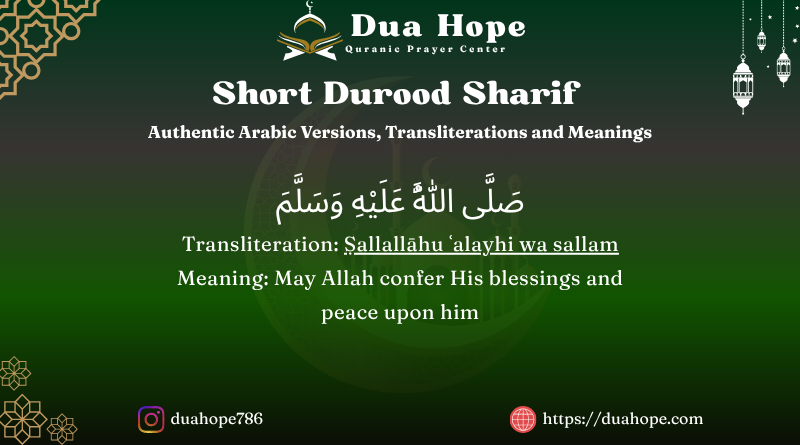
صَلَّى اللَّهُ عَلَيْهِ وَسَلَّمَ
Transliteration: Ṣallallāhu ʿalayhi wa sallam
Meaning: May Allah confer His blessings and peace upon him
When To Use: Upon hearing, reading, or writing the Prophet’s name (ﷺ)
Scholarly consensus: obligatory (wājib) upon first mention per sitting – Imam al-Nawawi, Al-Adhkar
Simple Dhikr form — Allahumma Salli Ala Muhammad
This is the most widely used form for repetitive dhikr outside of salah. Its brevity makes it suitable for continuous recitation throughout the day.
اَللّٰهُمَّ صَلِّ عَلَىٰ مُحَمَّدٍ
Transliteration: Allāhumma ṣalli ʿalā Muḥammad
Meaning: O Allah, send Your grace and honour upon Muhammad
Best For: Daily dhikr, Fridays, high-volume recitation
Mentioned in collections as a condensed form of Salawat — Ibn Majah, Sunan, hadith no. 907
Family-inclusive form (Ahl al-Bayt)
This form extends blessings to the Prophet’s household and is accepted by scholars of all schools. It appears in several hadith narrations and is considered more complete than the simple form.
اَللّٰهُمَّ صَلِّ عَلَىٰ مُحَمَّدٍ وَعَلَىٰ آلِ مُحَمَّدٍ
TRANSLITERATION: Allāhumma ṣalli ʿalā Muḥammadin wa ʿalā āli Muḥammad
MEANING: O Allah, send blessings upon Muhammad and upon the family of Muhammad
Sahih al-Bukhari 3370; Sahih Muslim 406 — narrated by Ka’b ibn ‘Ujra (RA)
Sunnah form — combining Salah and Salam
Scholars such as Imam Ibn al-Qayyim note that a complete Durood should include both the request for Salah (divine grace) and Salam (peace). This form fulfils both requirements concisely.
اَللّٰهُمَّ صَلِّ وَسَلِّمْ عَلَىٰ نَبِيِّنَا مُحَمَّدٍ
Transliteration: Allāhumma ṣalli wa sallim ʿalā nabiyyinā Muḥammad
Meaning: O Allah, send prayers and peace upon our Prophet Muhammad
Best For: Friday recitation, responding to hardship, as a daily wird (litany)
Recommended for problems — Tirmidhi 2457, narrated by Ubayy ibn Ka’b (RA)
Note on Durood-e-Ibrahim: The most complete and universally agreed-upon form remains Durood-e-Ibrahim, recited in every salah (Bukhari 3370, Muslim 406). The short forms above are valid for dhikr outside of salah but do not substitute for it within the prayer.
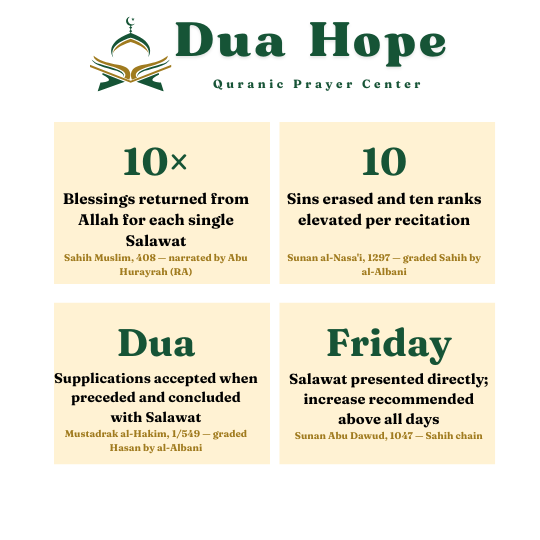
Rewards Established in Authenticated Hadith
Short Durood Sharif Transliteration in Urdu & English
| Form | English Transliteration | Scope |
| Shortest | Ṣallallāhu ʿalayhi wa sallam | Upon mention of the Prophet’s name |
| Simple | Allāhumma ṣalli ʿalā Muḥammad | Daily dhikr, beginners |
| Inclusive | Allāhumma ṣalli ʿalā Muḥammad wa ʿalā āli Muḥammad | More complete; includes family |
| Sunnah | Allāhumma ṣalli wa sallim ʿalā nabiyyinā Muḥammad | Friday, hardship, daily wird |
FAQ
Is it valid to recite a short Durood instead of Durood-e-Ibrahim?
Yes, outside of salah. Within the prayer, Durood-e-Ibrahim is the established Sunnah and cannot be replaced. For dhikr, study circles, and daily remembrance, the short forms above are fully valid and rewarded. Imam al-Nawawi in Al-Adhkar states that any form that conveys Salah upon the Prophet is acceptable.
How many times should I recite short Durood Sharif daily?
There is no fixed minimum set by the Prophet (ﷺ). However, when a companion asked whether he should devote all his supplication time to Salawat, the Prophet replied that Allah would then “suffice him in his worldly and spiritual affairs.” (Tirmidhi 2457 — Hasan Sahih). Scholars often recommend at minimum 10–100 recitations daily, with greater emphasis on Fridays.
Which short Durood is best for hardship or problems?
Scholars most commonly cite the Sunnah form: Allāhumma ṣalli wa sallim ʿalā nabiyyinā Muḥammad, because it combines both requests — divine grace (Salah) and peace (Salam). The Hakim narration (graded Hasan) indicates that Duas are suspended until Salawat is sent, making it a recommended practice before any supplication.
Can Durood Sharif be recited without wudu?
Yes. The scholarly consensus (ijma’) is that dhikr, including Salawat, is permissible without wudu, while walking, or in any clean state. Wudu is obligatory only for salah and touching the Quran. Being in a state of ritual purity, however, is always more virtuous.
Why is Friday especially recommended for Durood Sharif?
The Prophet (ﷺ) said: “Increase your Salawat upon me on Friday, for your Salawat are presented to me.” (Abu Dawud 1047, authenticated chain). Imam Ibn al-Qayyim in Jala’ al-Afham dedicates an entire chapter to this narration, noting that Friday holds a unique spiritual station in the week, making Salawat on that day particularly meritorious.